Market Analysis

Dubai's Supply Wave: 162,500 Homes Scheduled for 2027 and Where the Off-Plan Risk Sits

مدة القراءة 10 دقيقة

ValuStrat index -10% from the 28 Feb peak. 24,800 homes delivered in H1 2026, 162,500 scheduled for 2027. Resales -59%, off-plan -12%. Five districts hold 45% of the pipeline. Where Dubai's supply wave lands. #Dubai #OffPlan #DubaiRealEstate #INTRIC

Abhii DabasByAbhii Dabas

باختصار

Dubai residential prices peaked on 28 February 2026 and the ValuStrat index has since fallen 10%, leaving it flat year on year. The city delivered a record 24,800 homes in H1 2026 with 47,000 scheduled for H2 and 162,500 for 2027, though only half to two-thirds of scheduled units historically arrive. Resales fell 59% in Q2 while off-plan fell 12%. Exposure is concentrated in five districts and in studios and one-beds. Established villa enclaves are still rising.

أبرز النقاط

  • Dubai delivered 24,800 homes in H1 2026 (Cavendish Maxwell), the highest six-month total on record, against a schedule of 47,000 for H2 2026 and 162,500 for 2027. Historically only half to two-thirds of scheduled units arrive on time: Knight Frank puts the 2025 completion rate at 64%, up from 50% in 2024.
  • The ValuStrat Price Index fell 10% from its 28 February 2026 peak to June, taking it flat year on year. Apartments are down 3% on the year, villas up 2%. Cavendish Maxwell has the citywide average at AED 1,639 per square foot, down 2.6% on the quarter.
  • Transactions are down sharply but the fall is in resales, not off-plan. Betterhomes counted secondary sales down 59% year on year in Q2 2026 against off-plan down 12%. Off-plan is now three-quarters of all residential deals.
  • Exposure is concentrated: about 45% of stock under construction sits in JVC/JVT, Dubai South, MBR City, Business Bay and Dubailand Residence Complex, and about 66% of it is studios and one-beds. Established villa enclaves and DIFC are rising while Burj Khalifa area apartments are down 16.7% on the year.
  • Fitch (May 2025) capped the expected correction at 15%. Moody's (September 2025) expects a modest correction from 2026 led by mid-market apartments, S&P (January 2026) expects moderation rather than a fall, and UBS has moved Dubai to elevated bubble risk.

مقدمة

On 28 February 2026 the ValuStrat Price Index for Dubai residential property hit its high. By June it had given back 10%. The index that had risen almost 60% between 2022 and early 2025 on Fitch's count now sits at 220 points, 0.1% above where it was in June 2025, with apartments down 3% on the year and villas up 2%. In the same month Cavendish Maxwell reported that the city had handed over 24,800 homes in the first half of the year, the most in any six-month period on its records, with 47,000 more scheduled for the second half and 162,500 pencilled in for 2027. Dubai has never delivered anything close to its scheduled pipeline. What matters is which half of the schedule arrives, and where.

What the delivery numbers say

Cavendish Maxwell counts 24,800 completions in the first half of 2026, split 18,900 apartments and 5,900 villas and townhouses, up 37.6% on the first half of 2025. CBRE counts about 18,000 for the same period and ValuStrat about 20,000. The gap is definitional: each firm decides differently when a tower counts as handed over, and none of them has access to a single official completions register. Buyers should take the range, 18,000 to 25,000 in six months, and not the headline.

The second-half schedule is 47,000 units, 82.5% of them apartments. Cavendish itself expects 14,000 to 23,500 of those to arrive before year end, which is a materialisation rate of 30% to 50%. Knight Frank measured 2025 at 39,700 completions against the schedule, a 64% rate, and 2024 at 50%. The long-run average delivery in Dubai is about 36,000 homes a year. In both 2024 and 2025 the schedule was roughly double that average, and both years the outturn landed closer to the average than to the schedule.

Dubai residential handovers: schedule versus outturn
PeriodScheduledDeliveredRateSource
2024~61,000 (implied by rate)30,50050%Knight Frank
2025~62,000 (implied by rate)39,70064%Knight Frank
H1 2026n/a24,800n/aCavendish Maxwell
H2 202647,00014,000 to 23,500 expected30 to 50%Cavendish Maxwell
2027162,500n/an/aCavendish Maxwell
2028128,200n/an/aCavendish Maxwell

Cavendish quoted 146,400 for 2027 in its first-quarter report and 162,500 in its half-year report, and Knight Frank forecast more than 160,000 units for 2026 alone in February. Khaleej Times quoted roughly 55,000 for 2026 and 75,000 for 2027 in the same month. They differ by a factor of two or three. It depends on whether a firm counts launched, permitted, under construction or likely.

The price turn and the war month

The ValuStrat index rose almost 60% between 2022 and the first quarter of 2025 on Fitch's count. It kept rising for another year. The turn came in March 2026, the month Dubai's population fell by 61,000 at the height of the Iran war, and the index dropped 6% in that single month. The declines then shrank each month, to 1% by June. The population had recovered to 4.74 million by the end of June, up 157,000 for the year, and the June transaction data showed ready-home sales up 46.8% on May.

Cavendish Maxwell has the average sale price at AED 1,639 per square foot in June, down 2.6% on the quarter and up 1.9% on the year. Gross yields sit around 7% for apartments and 5% for villas. Rents are where the indices disagree most: CBRE has second-quarter rents down 6.2% on the quarter and 2.6% on the year, Cavendish has them up 7.8% on the year, ValuStrat has apartments up 1.3% and villas up 2.2%. The sign of the rent number depends on which index you read.

Resales down 59%, off-plan down 12%

The Dubai Land Department recorded AED 419.94 billion of transactions across 112,850 deals in the first half of 2026. Sales alone were AED 286.44 billion over 86,000 deals, of which 58,840 were off-plan. Betterhomes' second-quarter count is the one that shows the shape of the market: 34,850 residential deals, down 31% on a year earlier, worth AED 84.9 billion, down 45%. Inside that, resales fell 59% to 8,512 while off-plan fell 12% to 26,338. Off-plan was 76% of activity.

That split matters more than the headline decline. Secondary sellers are the ones who set the price when a market turns, and they have stopped transacting. Developers are still selling because they control the payment plan, and a deposit with the balance spread over construction is a cheaper way to hold a Dubai position than a mortgage at current rates. The buyer of an off-plan studio in Jumeirah Village Circle today is competing with the 2027 handover schedule for the same building.

A 12% fall in off-plan sales during a quarter when resales fell 59% is not resilience. It is a market where the only price discovery happening is the price the developer prints on the brochure.

The funding mix is the other quiet change. Provident's reading of Land Department data has cash at 64% of May 2026 purchases and mortgages at 36%, and Cavendish counted 22,500 mortgage transactions worth AED 51.3 billion in the first half. Knight Frank had cash at 86% of volume for the first nine months of 2025. The denominators differ, but the direction is the same: more mortgage-funded, and more dependent on off-plan.

Five districts, two-thirds studios and one-beds

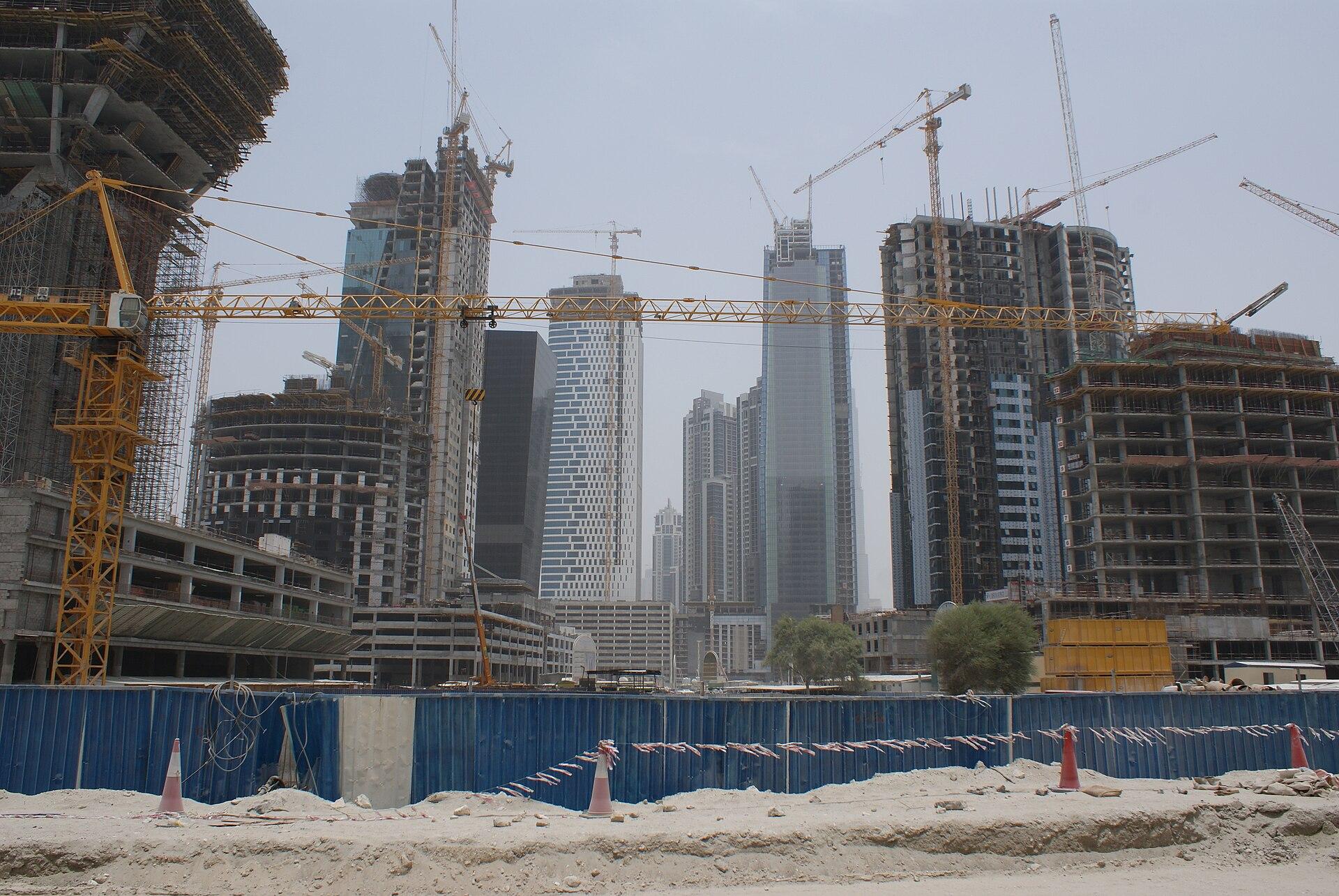
About 45% of the homes under construction in Dubai sit in five districts: Jumeirah Village Circle and Triangle, Dubai South, Mohammed Bin Rashid City, Business Bay and Dubailand Residence Complex. Roughly 66% of the pipeline is studios and one-bedroom units. Apartments are 86% of what is coming against 80% of what exists. Dubai South alone recorded 7,306 off-plan apartment sales in the first half of 2026, the most of any district.

The submarket data already shows the split that Moody's predicted a year ago. On ValuStrat's numbers to June 2026, apartments around Burj Khalifa are down 16.7% on the year, Jumeirah Beach Residence down 13% and Town Square down 5.7%, and among villas Mudon is down 5%, Victory Heights down 4% and International City down 3.2%. Against that, DIFC apartments are up 8.1%, Dubai Sports City up 6.6% and Silicon Oasis up 6.4%. Villas on Jumeirah Islands are up 17.9%, Emirates Hills up 10.7% and The Meadows up 10%. Betterhomes has Palm Jumeirah Garden Homes up 37% per square foot on the year.

A two-speed market
SubmarketTypeYoY to June 2026
Jumeirah IslandsVillas+17.9%
Emirates HillsVillas+10.7%
The MeadowsVillas+10.0%
DIFCApartments+8.1%
Dubai Sports CityApartments+6.6%
Town SquareApartments-5.7%
Jumeirah Beach ResidenceApartments-13.0%
Burj Khalifa areaApartments-16.7%
Source: ValuStrat VPI, June 2026

Every rising submarket in that table is one where nobody can build more. The falling ones are either a district with a tower cluster still to complete or a resort-style address whose buyers were paying for a view that the next tower will block. The Burj Khalifa area is the one losing value fastest.

What Fitch, Moody's and S&P got right so far

Fitch Ratings said on 29 May 2025 that Dubai prices would see a moderate correction from the second half of 2025 into 2026, of no more than 15%, and that the banks and homebuilders it rates could absorb it without downgrades. Its model assumed 120,000 completions in 2026 and 5% annual population growth. Moody's said on 10 September 2025 that more than 150,000 new homes between 2025 and 2027 represented about 20% of the existing stock and would produce a modest correction from 2026, with mid-market apartments most exposed and villas holding up in the near term. S&P Global said in January 2026 that population growth would absorb the supply and that prices would moderate over the following 12 to 24 months rather than fall. UBS placed Dubai in the elevated-risk bracket of its 2025 Global Real Estate Bubble Index, the largest risk increase of any city it covers, noting that building permits were back near 2017 levels, the last year the market turned down.

Sixteen months after the Fitch note, the ValuStrat index has fallen 10% from peak, the Fitch ceiling has not been breached, and the population dip in March was reversed by June. The delivery figures for the first half of 2026 came in between the Moody's and Fitch assumptions. None of the three has been proven wrong yet.

For a cross-border buyer the practical positions are narrow. A completed villa in a district with no remaining land, bought from a motivated resale seller in a quarter when resale volumes are down 59%, is the one trade the data supports. A studio or one-bedroom apartment bought off-plan in any of the five concentration districts for handover in 2027 is the one it does not, because the buyer is paying today's brochure price for delivery into the largest handover year in the city's history. The 2027 schedule of 162,500 units will not all arrive. Enough of it will.

الأسئلة الشائعة

How many homes is Dubai actually delivering in 2026?
Dubai handed over 24,800 homes in the first half of 2026 according to Cavendish Maxwell, a 37.6% rise on the same period of 2025. CBRE counts about 18,000 and ValuStrat about 20,000 for the same six months, because each firm tracks completions differently. A further 47,000 units are scheduled for the second half, but Cavendish expects only 14,000 to 23,500 of them to be delivered on time.
Have Dubai property prices started falling in 2026?
Yes, on the main indices. The ValuStrat Price Index peaked on 28 February 2026 and had fallen 10% by June, leaving it flat year on year at 220 points. Apartments were down 3% on the year and villas up 2%. Cavendish Maxwell put the citywide average at AED 1,639 per square foot in June, down 2.6% on the quarter but still 1.9% above June 2025. The monthly declines shrank from 6% in March to 1% in June.
Is off-plan still selling?
Off-plan sales are holding up far better than resales. Betterhomes counted 34,850 residential deals in the second quarter of 2026, down 31% on a year earlier, but secondary-market sales fell 59% while off-plan sales fell only 12%. Off-plan now accounts for roughly three-quarters of all residential transactions on the ValuStrat, Betterhomes and Cavendish Maxwell counts.
Which areas are most exposed to oversupply?
Five districts hold about 45% of everything under construction: Jumeirah Village Circle and Triangle, Dubai South, Mohammed Bin Rashid City, Business Bay and Dubailand Residence Complex. About two-thirds of the pipeline is studios and one-bedroom apartments. On the ValuStrat index, apartments around Burj Khalifa fell 16.7% in the year to June 2026 and Jumeirah Beach Residence fell 13%. DIFC apartments rose 8.1% and villas on Jumeirah Islands rose 17.9%.
What do the rating agencies expect?
Fitch Ratings said in May 2025 that prices could fall by no more than 15% from the second half of 2025 into 2026. Moody's said in September 2025 to expect a modest correction from 2026, with mid-market apartments most exposed. S&P Global said in January 2026 that population growth would absorb the supply and that it expected prices to moderate rather than fall, while UBS moved Dubai into its elevated-risk bracket in the 2025 bubble index, the largest jump of any city it tracks.
Author
Abhii Dabas
Abhii DabasFounder & CEO, INTRIC Global

Abhii Dabas is the Founder and CEO of INTRIC Global, the cross-border property intelligence platform for serious investors. He advises high-net-worth buyers on international real estate strategy across more than 40 countries and has tracked the Dubai off-plan market through its last correction and the recovery that followed, the cycle the current delivery schedule is now being measured against.
شارك

المزيد من رؤى السوق

عرض الكل

Join the INTRIC newsletter

Curated market intelligence, new buying guides and the listings worth knowing about, across 70+ markets.

No spam, unsubscribe any time.