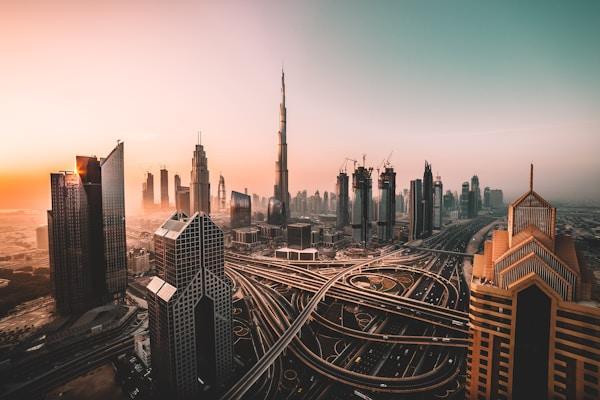
Dubai's Luxury Real Estate Boom: Record Transactions, Golden Visa Economics, and Where to Position in 2026
Introduction
Dubai's real estate market entered 2026 in historic form, recording AED 72.4 billion in transactions in January alone — the highest ever monthly sales figure in the emirate's history and a 63% year-on-year increase. By the close of Q1 2026, total transaction value had reached AED 252 billion across 44,150 deals, a 31% surge compared with Q1 2025. The luxury segment — properties valued at AED 10 million and above — is leading the charge, posting 2,076 transactions worth AED 43.7 billion in Q1 2026, with off-plan deals accounting for 77% of that value and villas representing 73% of luxury volume. Median prices across the market stand at AED 1,770 per square foot, up 14% year-on-year. What is unfolding is not a cyclical rally but a structural realignment of global HNW capital toward Dubai, driven by tax efficiency, Golden Visa residency certainty, and a quality-of-life proposition that legacy wealth centres like London and Singapore are increasingly struggling to match.
Record-Breaking Transaction Data: Reading the Numbers
- Q1 2026 Sets a New Benchmark for Gulf Property:Dubai's real estate sector recorded AED 252 billion in total Q1 2026 transactions — a 31% year-on-year increase in value on a 6% rise in deal volume, indicating that the market is being driven by ticket size expansion, not just deal count. January 2026's AED 72.4 billion result represents the strongest single month in Dubai's recorded history, surpassing previous records set during the 2013-2014 cycle and the 2021-2022 post-pandemic surge. Full-year 2025 reached AED 525.87 billion — itself a record — and the trajectory through Q1 2026 suggests 2026 could materially exceed that figure. The data reflects a market where both owner-occupier demand from relocating HNWIs and institutional off-plan investment from international family offices are compressing simultaneously.
- The Luxury Segment Reaches Critical Mass:Properties priced at AED 10 million and above recorded 2,076 transactions worth AED 43.7 billion in Q1 2026 — a category that barely registered a decade ago and now constitutes a mature, liquid segment in its own right. The single most expensive transaction in Q1 was the AED 422 million sale at Aman Residences Tower 2, while the most expensive villa closed at AED 350 million at Jumeirah First. In April 2026, the luxury segment posted 995 transactions, an all-time high for any April in Dubai's history and a 5.9% share of total market volume by deal count. Demand is concentrated in Jumeirah Bay Island, Palm Jumeirah, World Islands, La Mer, and JBR — communities where exclusivity, waterfront access, and resort-grade amenity stacks have created defensible value floors.
- Price Appreciation: Persistent but Not Uniform:The citywide median of AED 1,770 per square foot conceals significant variation. Palm Jumeirah villas have sustained price growth well above the city average, while certain oversupplied apartment submarkets closer to secondary corridors have seen softer momentum. CBRE's Dubai residential index tracks prime apartment prices up 11-14% year-on-year in Q1 2026, with prime villa prices appreciating 16-20% across select waterfront communities. This divergence underscores the importance of micro-location analysis: investors treating Dubai as a homogeneous market are systematically misallocating capital away from the outperforming submarkets and toward areas where supply pipelines are heavier and yield compression is more advanced.
Golden Visa Architecture: How Residency Drives Real Estate
- AED 2 Million Threshold Anchors Global HNW Demand:The UAE Golden Visa requires a minimum real estate investment of AED 2 million to qualify for a 10-year renewable residency visa — a threshold that is, by global standards, comparatively accessible for the target demographic. For comparison, Portugal's most active Golden Visa pathway now requires EUR 500,000 in investment funds (not property), while Greece has raised its property threshold to EUR 800,000 in prime zones. Dubai's AED 2 million entry point, combined with 0% personal income tax and 0% capital gains tax on property, creates an investment-to-residency calculus that is difficult to replicate in any comparable global city. Investors earning qualifying passive income, dividends, or business proceeds can hold Dubai property as the anchor of a comprehensive tax structure, not merely as a lifestyle asset.
- HNW Migration Patterns: London and Singapore Losing Ground:Henley & Partners' 2025 migration data showed a net outflow of approximately 9,500 millionaires from the UK, with Dubai as the single most popular destination for relocating HNWIs globally. A similar pattern is observable from Russia, India, China, and increasingly from European jurisdictions where wealth taxes and regulatory complexity are accelerating departure decisions. The consequence for Dubai's residential market is structural rather than speculative: buyers are not purchasing for yield rotation cycles but as primary or secondary residences, creating an owner-occupier substrate beneath the investment market that supports price floors. Branded residences — Aman, Four Seasons, Bulgari, Armani — have become the preferred product for this cohort, combining lifestyle certainty with international brand equity that translates across cultures.
- Short-Term Rental Economy: A Secondary Yield Layer:Beyond long-term capital appreciation, Dubai's 22,719 active short-term rental listings — with median annual revenue of AED 172,000 and an average occupancy rate of 73% — provide property owners with a meaningful yield layer that long-term tenancies do not capture. Dubai Marina, Downtown, and Palm Jumeirah properties are the strongest performers in the STR segment, benefiting from the emirate's 21 million international visitors recorded in 2025. Mid-market apartments in licensed STR zones deliver gross yields of 7-9%, while premium district properties sustain 5-7% gross on an STR basis, supported by Dubai's growing profile as a long-stay destination for remote workers, regional expats, and nomadic business professionals.
Off-Plan Dominance and Structural Market Drivers
- Off-Plan Transactions Reach AED 73.4 Billion in Q1 2026:Off-plan sales rose from 25,000 transactions worth AED 53.9 billion in Q1 2025 to 30,000 transactions worth AED 73.4 billion in Q1 2026 — a 36% increase in value year-on-year and now the dominant deal type in the Dubai market. Developers including Emaar, Nakheel, DAMAC, and a growing cohort of boutique luxury operators have structured compelling payment plans — typically 20-30% down with post-handover schedules of 24-36 months — that allow investors to acquire at today's prices without committing full capital immediately. The off-plan mechanism has historically allowed Dubai to attract speculative capital that then converts to completed stock demand, and the Q1 2026 data suggests this flywheel is operating at full capacity with more than two years of pipeline visible in the permitting data.
- Infrastructure and Expo City Legacy Underpin Long-Run Demand:Dubai's physical growth trajectory continues to expand the geographic surface of the prime market. Expo City Dubai — host of the 2020 World Expo — is evolving into a 4.38 square kilometre mixed-use district, attracting international organisations including COP-28 legacy institutions and UAE government entities. The Dubai 2040 Urban Master Plan designates five urban centres and five nature reserves, funnelling density toward planned corridors and away from unstructured sprawl. This institutional planning framework — uncommon among rapidly growing Gulf cities — provides investors with reasonable visibility over where infrastructure spending and population centres will concentrate, reducing location risk on long-duration property holds.
Risks and Considerations for International Investors
- Supply Pipeline and Cyclical Vulnerability:Dubai has historically been subject to sharp supply-demand imbalances, and the current off-plan boom is building a delivery pipeline that will materialise in completed stock over 2026-2028. Analysts at JLL and CBRE have flagged the risk that, if global macro conditions weaken or HNW migration trends decelerate, a supply glut in secondary apartment submarkets — particularly studio and one-bedroom units in outer districts — could emerge by late 2026. Investors should distinguish between prime waterfront product (where supply is structurally constrained and land is finite) and mid-market high-rise developments where competition for tenants may intensify as the pipeline delivers.
- Currency, Repatriation, and Regulatory Considerations:The AED is pegged to the USD at AED 3.67, providing currency stability for USD-denominated investors and eliminating forex risk for US, GCC, and dollarised-economy buyers. For European, UK, and Asian investors, the AED peg means exchange rate risk is effectively transferred to the buyer's home currency versus USD — a consideration that has benefited investors from weaker-currency environments (Indian rupee, Russian ruble, British pound in recent years) while being largely neutral for USD-zone buyers. Dubai imposes no restrictions on capital repatriation or profit remittance, and the UAE has a comprehensive network of double taxation agreements with more than 120 countries, providing legal clarity on cross-border income treatment.
- Geopolitical Context and the Gulf Risk Premium:The US-Iran tensions that escalated in early 2026 briefly disrupted tourism and business travel patterns in February-March, with STR data showing a significant shift from leisure bookings toward 29-day-plus displacement stays from regional expats. This episode illustrated both the geopolitical risk embedded in Gulf real estate — Dubai's proximity to regional conflict theatres is non-trivial — and the market's resilience: the displacement demand from regional residents and corporate relocators offset leisure cancellations, and the broader transaction market continued its record-setting pace through Q1. Investors pricing Gulf risk correctly should apply a risk premium appropriate to the region while recognising that Dubai's financial and diplomatic positioning has, to date, provided meaningful insulation from regional volatility.
Investment Strategy: Positioning for the Dubai Premium
- Prime Waterfront and Branded Residences for Capital Preservation:For capital preservation with moderate yield, prime waterfront villas on Palm Jumeirah, Jumeirah Bay Island, and the World Islands offer the strongest structural demand characteristics — finite land, globally recognisable address value, and a buyer pool of ultra-HNWIs who are price-inelastic. Entry costs in this segment start at AED 15-25 million for established villas and exceed AED 100 million for super-prime beachfront product. Branded residences — Aman, Bulgari, Six Senses, Mandarin Oriental — command a brand premium of 30-60% over comparable unbranded square footage and deliver superior resale liquidity to international buyers who value institutional quality signals.
- Golden Visa Entry Point and Yield-Focused Mid-Market Strategy:For investors targeting the Golden Visa threshold at AED 2 million, Dubai Marina, Business Bay, and Downtown apartments offer a practical entry: established communities with strong rental demand, 10-year visa eligibility, and gross yields in the 6-8% range for well-located, competitively managed units. This segment has historically had the highest transaction liquidity in the Dubai market, meaning exit positions are achievable within realistic timeframes. Investors should target completed stock over off-plan in this segment — the off-plan premium is harder to justify below the AED 3 million level where developer payment plan incentives are less differentiated and secondary market competition on completed units is robust.
Sources
- Property Finder — Dubai's real estate market opens 2026 with its highest ever monthly sales of AED 72.4bn
- Gulf News — Dubai real estate transactions jump 31% to Dh252b in Q1 2026
- Gulf News — Sale of $10m homes breaks records in Q1 in Dubai
- Arabian Business — Dubai property market opens 2026 with record $19.7bn in transactions
- GuestReady — The rise of the short-term rental market in Dubai for 2026
- Airbtics — Dubai Airbnb Data 2026: Revenue, Occupancy & ROI Insights
- BetterHomes — Will Dubai Property Prices Rise or Fall in 2026?
- Engel & Völkers — Dubai Housing Market 2026: Prices, Trends, Supply & What to Expect

Abhii Dabas is the Founder and CEO of INTRIC Global, the cross-border property intelligence platform for serious investors. He advises high-net-worth buyers on international real estate strategy and has evaluated residential markets across more than 40 countries.
Share
Share this article with others
Introduction
Dubai's real estate market entered 2026 in historic form, recording AED 72.4 billion in transactions in January alone — the highest ever monthly sales figure in the emirate's history and a 63% year-on-year increase. By the close of Q1 2026, total transaction value had reached AED 252 billion across 44,150 deals, a 31% surge compared with Q1 2025. The luxury segment — properties valued at AED 10 million and above — is leading the charge, posting 2,076 transactions worth AED 43.7 billion in Q1 2026, with off-plan deals accounting for 77% of that value and villas representing 73% of luxury volume. Median prices across the market stand at AED 1,770 per square foot, up 14% year-on-year. What is unfolding is not a cyclical rally but a structural realignment of global HNW capital toward Dubai, driven by tax efficiency, Golden Visa residency certainty, and a quality-of-life proposition that legacy wealth centres like London and Singapore are increasingly struggling to match.
Record-Breaking Transaction Data: Reading the Numbers
- Q1 2026 Sets a New Benchmark for Gulf Property:Dubai's real estate sector recorded AED 252 billion in total Q1 2026 transactions — a 31% year-on-year increase in value on a 6% rise in deal volume, indicating that the market is being driven by ticket size expansion, not just deal count. January 2026's AED 72.4 billion result represents the strongest single month in Dubai's recorded history, surpassing previous records set during the 2013-2014 cycle and the 2021-2022 post-pandemic surge. Full-year 2025 reached AED 525.87 billion — itself a record — and the trajectory through Q1 2026 suggests 2026 could materially exceed that figure. The data reflects a market where both owner-occupier demand from relocating HNWIs and institutional off-plan investment from international family offices are compressing simultaneously.
- The Luxury Segment Reaches Critical Mass:Properties priced at AED 10 million and above recorded 2,076 transactions worth AED 43.7 billion in Q1 2026 — a category that barely registered a decade ago and now constitutes a mature, liquid segment in its own right. The single most expensive transaction in Q1 was the AED 422 million sale at Aman Residences Tower 2, while the most expensive villa closed at AED 350 million at Jumeirah First. In April 2026, the luxury segment posted 995 transactions, an all-time high for any April in Dubai's history and a 5.9% share of total market volume by deal count. Demand is concentrated in Jumeirah Bay Island, Palm Jumeirah, World Islands, La Mer, and JBR — communities where exclusivity, waterfront access, and resort-grade amenity stacks have created defensible value floors.
- Price Appreciation: Persistent but Not Uniform:The citywide median of AED 1,770 per square foot conceals significant variation. Palm Jumeirah villas have sustained price growth well above the city average, while certain oversupplied apartment submarkets closer to secondary corridors have seen softer momentum. CBRE's Dubai residential index tracks prime apartment prices up 11-14% year-on-year in Q1 2026, with prime villa prices appreciating 16-20% across select waterfront communities. This divergence underscores the importance of micro-location analysis: investors treating Dubai as a homogeneous market are systematically misallocating capital away from the outperforming submarkets and toward areas where supply pipelines are heavier and yield compression is more advanced.
Golden Visa Architecture: How Residency Drives Real Estate
- AED 2 Million Threshold Anchors Global HNW Demand:The UAE Golden Visa requires a minimum real estate investment of AED 2 million to qualify for a 10-year renewable residency visa — a threshold that is, by global standards, comparatively accessible for the target demographic. For comparison, Portugal's most active Golden Visa pathway now requires EUR 500,000 in investment funds (not property), while Greece has raised its property threshold to EUR 800,000 in prime zones. Dubai's AED 2 million entry point, combined with 0% personal income tax and 0% capital gains tax on property, creates an investment-to-residency calculus that is difficult to replicate in any comparable global city. Investors earning qualifying passive income, dividends, or business proceeds can hold Dubai property as the anchor of a comprehensive tax structure, not merely as a lifestyle asset.
- HNW Migration Patterns: London and Singapore Losing Ground:Henley & Partners' 2025 migration data showed a net outflow of approximately 9,500 millionaires from the UK, with Dubai as the single most popular destination for relocating HNWIs globally. A similar pattern is observable from Russia, India, China, and increasingly from European jurisdictions where wealth taxes and regulatory complexity are accelerating departure decisions. The consequence for Dubai's residential market is structural rather than speculative: buyers are not purchasing for yield rotation cycles but as primary or secondary residences, creating an owner-occupier substrate beneath the investment market that supports price floors. Branded residences — Aman, Four Seasons, Bulgari, Armani — have become the preferred product for this cohort, combining lifestyle certainty with international brand equity that translates across cultures.
- Short-Term Rental Economy: A Secondary Yield Layer:Beyond long-term capital appreciation, Dubai's 22,719 active short-term rental listings — with median annual revenue of AED 172,000 and an average occupancy rate of 73% — provide property owners with a meaningful yield layer that long-term tenancies do not capture. Dubai Marina, Downtown, and Palm Jumeirah properties are the strongest performers in the STR segment, benefiting from the emirate's 21 million international visitors recorded in 2025. Mid-market apartments in licensed STR zones deliver gross yields of 7-9%, while premium district properties sustain 5-7% gross on an STR basis, supported by Dubai's growing profile as a long-stay destination for remote workers, regional expats, and nomadic business professionals.
Off-Plan Dominance and Structural Market Drivers
- Off-Plan Transactions Reach AED 73.4 Billion in Q1 2026:Off-plan sales rose from 25,000 transactions worth AED 53.9 billion in Q1 2025 to 30,000 transactions worth AED 73.4 billion in Q1 2026 — a 36% increase in value year-on-year and now the dominant deal type in the Dubai market. Developers including Emaar, Nakheel, DAMAC, and a growing cohort of boutique luxury operators have structured compelling payment plans — typically 20-30% down with post-handover schedules of 24-36 months — that allow investors to acquire at today's prices without committing full capital immediately. The off-plan mechanism has historically allowed Dubai to attract speculative capital that then converts to completed stock demand, and the Q1 2026 data suggests this flywheel is operating at full capacity with more than two years of pipeline visible in the permitting data.
- Infrastructure and Expo City Legacy Underpin Long-Run Demand:Dubai's physical growth trajectory continues to expand the geographic surface of the prime market. Expo City Dubai — host of the 2020 World Expo — is evolving into a 4.38 square kilometre mixed-use district, attracting international organisations including COP-28 legacy institutions and UAE government entities. The Dubai 2040 Urban Master Plan designates five urban centres and five nature reserves, funnelling density toward planned corridors and away from unstructured sprawl. This institutional planning framework — uncommon among rapidly growing Gulf cities — provides investors with reasonable visibility over where infrastructure spending and population centres will concentrate, reducing location risk on long-duration property holds.
Risks and Considerations for International Investors
- Supply Pipeline and Cyclical Vulnerability:Dubai has historically been subject to sharp supply-demand imbalances, and the current off-plan boom is building a delivery pipeline that will materialise in completed stock over 2026-2028. Analysts at JLL and CBRE have flagged the risk that, if global macro conditions weaken or HNW migration trends decelerate, a supply glut in secondary apartment submarkets — particularly studio and one-bedroom units in outer districts — could emerge by late 2026. Investors should distinguish between prime waterfront product (where supply is structurally constrained and land is finite) and mid-market high-rise developments where competition for tenants may intensify as the pipeline delivers.
- Currency, Repatriation, and Regulatory Considerations:The AED is pegged to the USD at AED 3.67, providing currency stability for USD-denominated investors and eliminating forex risk for US, GCC, and dollarised-economy buyers. For European, UK, and Asian investors, the AED peg means exchange rate risk is effectively transferred to the buyer's home currency versus USD — a consideration that has benefited investors from weaker-currency environments (Indian rupee, Russian ruble, British pound in recent years) while being largely neutral for USD-zone buyers. Dubai imposes no restrictions on capital repatriation or profit remittance, and the UAE has a comprehensive network of double taxation agreements with more than 120 countries, providing legal clarity on cross-border income treatment.
- Geopolitical Context and the Gulf Risk Premium:The US-Iran tensions that escalated in early 2026 briefly disrupted tourism and business travel patterns in February-March, with STR data showing a significant shift from leisure bookings toward 29-day-plus displacement stays from regional expats. This episode illustrated both the geopolitical risk embedded in Gulf real estate — Dubai's proximity to regional conflict theatres is non-trivial — and the market's resilience: the displacement demand from regional residents and corporate relocators offset leisure cancellations, and the broader transaction market continued its record-setting pace through Q1. Investors pricing Gulf risk correctly should apply a risk premium appropriate to the region while recognising that Dubai's financial and diplomatic positioning has, to date, provided meaningful insulation from regional volatility.
Investment Strategy: Positioning for the Dubai Premium
- Prime Waterfront and Branded Residences for Capital Preservation:For capital preservation with moderate yield, prime waterfront villas on Palm Jumeirah, Jumeirah Bay Island, and the World Islands offer the strongest structural demand characteristics — finite land, globally recognisable address value, and a buyer pool of ultra-HNWIs who are price-inelastic. Entry costs in this segment start at AED 15-25 million for established villas and exceed AED 100 million for super-prime beachfront product. Branded residences — Aman, Bulgari, Six Senses, Mandarin Oriental — command a brand premium of 30-60% over comparable unbranded square footage and deliver superior resale liquidity to international buyers who value institutional quality signals.
- Golden Visa Entry Point and Yield-Focused Mid-Market Strategy:For investors targeting the Golden Visa threshold at AED 2 million, Dubai Marina, Business Bay, and Downtown apartments offer a practical entry: established communities with strong rental demand, 10-year visa eligibility, and gross yields in the 6-8% range for well-located, competitively managed units. This segment has historically had the highest transaction liquidity in the Dubai market, meaning exit positions are achievable within realistic timeframes. Investors should target completed stock over off-plan in this segment — the off-plan premium is harder to justify below the AED 3 million level where developer payment plan incentives are less differentiated and secondary market competition on completed units is robust.
Sources
- Property Finder — Dubai's real estate market opens 2026 with its highest ever monthly sales of AED 72.4bn
- Gulf News — Dubai real estate transactions jump 31% to Dh252b in Q1 2026
- Gulf News — Sale of $10m homes breaks records in Q1 in Dubai
- Arabian Business — Dubai property market opens 2026 with record $19.7bn in transactions
- GuestReady — The rise of the short-term rental market in Dubai for 2026
- Airbtics — Dubai Airbnb Data 2026: Revenue, Occupancy & ROI Insights
- BetterHomes — Will Dubai Property Prices Rise or Fall in 2026?
- Engel & Völkers — Dubai Housing Market 2026: Prices, Trends, Supply & What to Expect
Abhii Dabas is the Founder and CEO of INTRIC Global, the cross-border property intelligence platform for serious investors. He advises high-net-worth buyers on international real estate strategy and has evaluated residential markets across more than 40 countries.
Share this article
Share this insight with others
Share
Share this article with others
Related Market Insights
View More Market Insights
Market Analysis
China's 35-Month Decline and Hong Kong's Recovery: Why "China Property" Is Not One Trade
By Abhii Dabas · July 10, 2026

Market Analysis
Nordic Real Estate in 2026: Record Institutional Capital Meets Europe's Worst Housing Shortage
By Abhii Dabas · June 25, 2026

Market Analysis
Spain and Iberia in 2026: Europe's Top Investment Market Navigates a Housing Paradox
By Abhii Dabas · June 25, 2026
Found this useful? Send it to someone who should read it.
Continue with INTRIC